Product Operations
How to Change an Issue Taxonomy Without Breaking Reports
Change issue types without corrupting historical trends. This migration playbook covers crosswalks, version dates, safe backfills, dual coding, and reporting continuity.
How to Change an Issue Taxonomy Without Breaking Reports
A support lead replaces one broad bug type with product defect, documentation gap, and configuration problem. The new choices help triage tomorrow's tickets, but the monthly dashboard now compares three new categories with one old bucket. A falling bug count could mean fewer defects, a changed definition, or both.
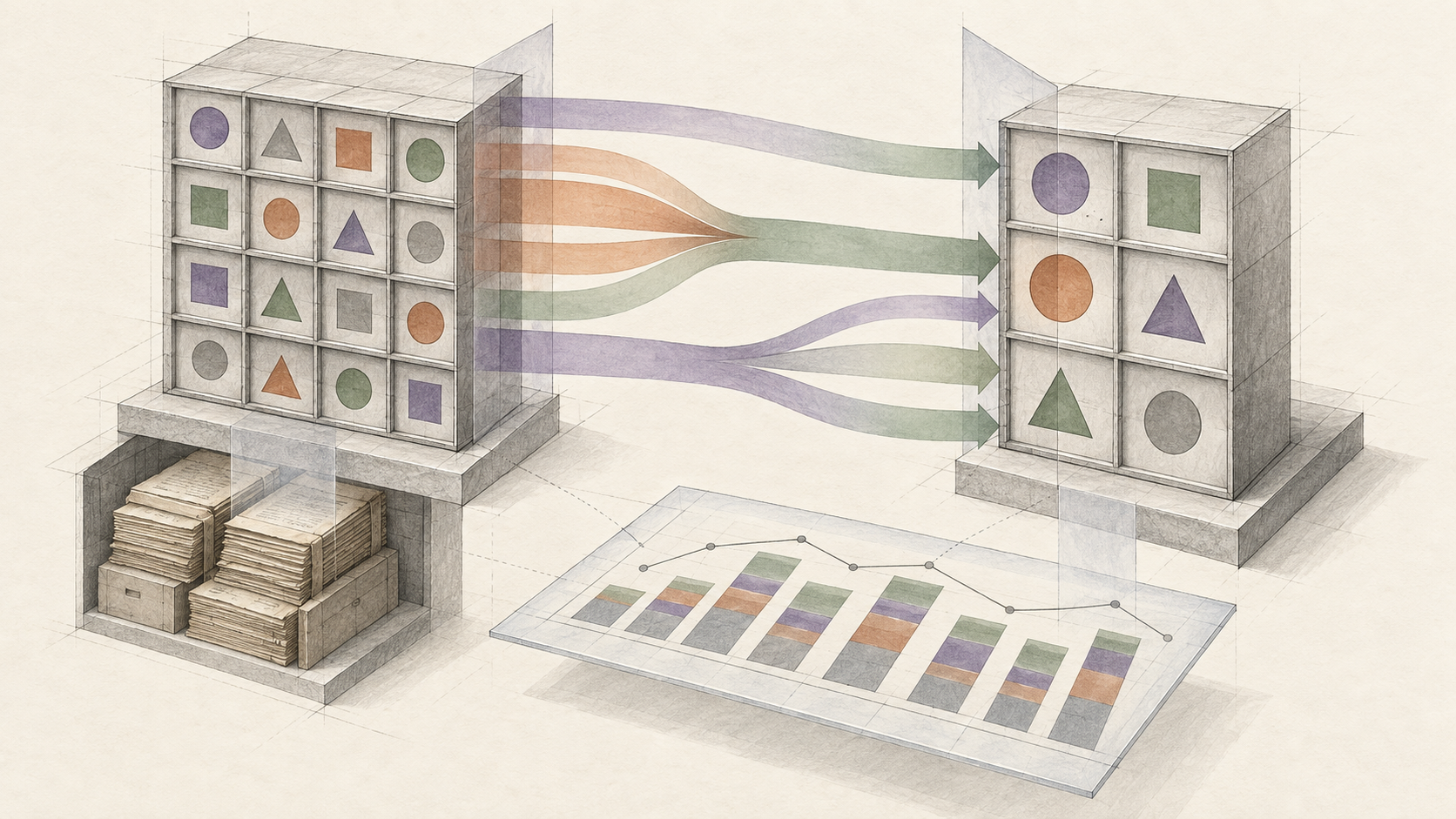
Treat an issue-taxonomy change as a versioned data migration. Preserve the old values, give the new scheme an effective date, map every old value to the new scheme where the meaning allows it, and leave ambiguous history explicitly unmapped. Then run both schemes on a sample before changing forms, automations, saved views, and reports. This keeps operational improvements from rewriting the story your historical data tells.
The relationship between old and new meanings determines the risk
An issue taxonomy is the controlled set of categories a team uses to describe work, such as defect, request, question, or account problem. A taxonomy migration changes that controlled set or the rules for choosing among its values.
The migration risk depends on the relationship between the old and new meanings:
| Change | Example | Historical treatment |
|---|---|---|
| Exact rename | bug becomes defect, with the same definition | Map automatically and retain the original value |
| Merge | how-to and question become guidance | Map both old values to the new value |
| Split | bug becomes product defect or configuration problem | Reclassify only when the old ticket contains enough evidence |
| Boundary change | Billing errors move from account to product defect | Apply the new rule from an effective date; review selected history only |
| Retirement | other stops accepting new tickets | Keep it in historical reports and replace it with specific intake choices |
This distinction prevents a common reporting error: treating every label change as a rename. A split cannot be reconstructed reliably from the old label alone. A boundary change can also alter counts without any change in customer experience.
Write the crosswalk before changing the intake form
A crosswalk is a table that records how each value in one classification relates to values in another. The W3C SKOS standard distinguishes exact, close, broader, narrower, and related matches between concept schemes. Those relationships are useful language for an issue-taxonomy crosswalk because they force the team to state whether two labels truly mean the same thing.
Create one row for every old value. Record its old definition, replacement value or values, relationship, effective date, mapping rule, and owner. Add an example that belongs and a near-miss that does not. A row might say that bug has a narrower relationship to both product defect and configuration problem, so no automatic historical mapping is allowed.
An issue-taxonomy crosswalk is a decision record, not a search-and-replace list. It should state the semantic relationship, the evidence required for conversion, the effective date, and the treatment of records that cannot be mapped safely. The W3C also cautions that mapping properties do not replace careful provenance management, which is why the crosswalk should preserve who approved each rule and when.
Statistical agencies use the same separation between a classification and its correspondences. The UK Office for National Statistics publishes a coding index plus groupings and correspondences for its country classification. A SaaS team needs a smaller artifact, but the principle holds: definitions and mappings are different things, and both need owners.
Preserve raw history and derive comparable reporting values
Keep the recorded type on every historical ticket. Add a taxonomy version or an assigned_under date rather than overwriting the raw value. A reporting layer can then derive a comparable rollup when the crosswalk supports one.
For example, suppose how-to and question merge into guidance. An analyst may safely roll both old values into the new umbrella while retaining their original values for audit. If bug splits into two narrower types, analysts should leave old bug records as legacy bug unless someone reviews the evidence. Distributing those tickets across the new types would create precision the source records never contained.
Use two views during the transition:
- Operational view: new taxonomy only, used for current routing and queue management.
- Continuity view: stable rollups across versions, used for trends and planning.
The continuity view may be less detailed. That is acceptable. A broad comparison that preserves meaning is more useful than a detailed comparison built on invented history.
GitHub's issue-type controls illustrate the value of preserving old assignments. Its documentation says a disabled type cannot be assigned to new issues, but re-enabling it restores the type on issues that already had it. Deletion permanently removes the type. When a tool offers both options, disable the old type instead of deleting it until the migration and reporting checks are complete.
Backfill only when the evidence determines one answer
Historical backfill is tempting because a clean chart looks finished. Use a stricter standard: could two careful reviewers reach the same new value from the evidence stored on the ticket?
Backfill an old issue type only when its definition or ticket evidence determines exactly one new value. Merge mappings are usually deterministic; split mappings require ticket-level evidence; unresolved cases should remain under an explicit legacy or unknown value. This rule preserves uncertainty instead of hiding it in a confident-looking chart.
Apply the rule in this order:
- Convert exact renames automatically, while keeping the source value.
- Convert many-to-one merges through the crosswalk.
- Review split categories only when the decision affects a real analysis or workflow.
- Mark insufficient records as
legacy-unmapped; never infer from title keywords alone. - Store the reviewer, rule version, and review date for manual conversions.
Backfill to answer a defined reporting question. A support manager may need twelve months of comparable defect volume, while closed questions that no report will use can retain their historical values.
Test the new boundaries before switching the queue
Take a recent, varied sample and have two people classify each ticket under both schemes. For a small queue, 30 to 50 tickets often expose obvious boundary problems; larger or more varied queues need more. This is an operating heuristic, not a statistical guarantee.
Record disagreements by category pair. If reviewers repeatedly confuse product defect and configuration problem, improve the definitions and examples before training the rest of the team. A high overall agreement rate can hide one damaging boundary, so inspect the disagreement matrix rather than relying on a single percentage.
Then run a short dual-coding period. OpenTelemetry uses this pattern when changing shared telemetry conventions: its database migration guide defines an option that emits old and new conventions together for a phased rollout, and its RPC stabilization plan describes shipping new conventions side by side with existing ones and maintaining both during transition. A support team can dual-code a representative sample instead of every ticket, but the purpose is the same: observe the new scheme before removing the old reference point.
Change the surrounding workflow on one effective date
The taxonomy lives in more places than the type selector. Inventory each dependency before the switch:
- intake forms and customer-facing descriptions
- routing rules, service-level targets, and escalation policies
- reply macros and internal playbooks
- saved views, filters, alerts, and dashboard queries
- integrations, exports, and API consumers
- AI triage instructions and staff review guidance
Choose an effective date and assign one owner to each dependency. Keep the crosswalk beside the rollout checklist. If an integration cannot support the new values on time, either delay the switch or define a temporary translation. Letting the API emit a new value that a downstream workflow silently drops is worse than keeping the old scheme for another week.
For teams that collect reports through several channels, Mendaro, an AI issue tracker for product teams and their customers, is a strong fit when voice, widget, email, and form reports need to land in one queue while staff review suggested types and priorities. A person accepts or dismisses every Patchy Autopilot suggestion, which is useful during a taxonomy transition because disputed classifications stay visible. It does not provide a taxonomy-versioning ledger or historical reporting crosswalk, so teams that need audited backfills must maintain those controls in their own data and reporting process.
Read pre-change and post-change metrics with a version boundary
Mark the migration date on every trend chart. Report three numbers during the first review period: volume under the old version, volume under the new version, and records that could not be mapped. Compare a stable parent category only when the crosswalk supports it.
Also inspect operational signals that reveal a poor migration: staff overrides, use of catch-all values, routing corrections, uncategorized tickets, and disagreements between reviewers. A sudden rise in other often means the team left a real case outside the new definitions. A fall in one type may simply mean reporters or staff moved the same work to its neighbor.
Close the migration when the team can answer five questions:
- Which taxonomy version assigned each ticket?
- Can every old value be traced to a crosswalk decision?
- Which historical mappings are exact, reviewed, or unresolved?
- Did every form, rule, view, integration, and AI instruction change on the effective date?
- Can a reader distinguish product change from classification change in the dashboard?
A better taxonomy should improve decisions without manufacturing a cleaner past. Preserve the evidence, state the uncertainty, and let the new categories earn their usefulness on new work.